Pearson Edexcel · GCSE · Psychology
Course version: 1PS0 · Version from Sept 2017
Understand experimental and research designs, including strengths and…
Full specification wording
Designing psychological research: 11.1.6 Understand experimental and research designs, including strengths and weaknesses: a. independent measures b. repeated measures c. matched pairs
Experimental design dictates how participants are allocated to conditions.
Checked against the Pearson Edexcel 1PS0 specification (opens in a new tab) on .
- Point 6 of 17
- 3 key terms
Study notes
From the checked teaching notes for this specification point.
The idea
Experimental design dictates how participants are allocated to conditions. In an independent measures design, different participants are used in each condition (e.g., Group A drinks caffeine, Group B drinks water). This avoids order effects but introduces participant variables. A repeated measures design uses the same participants in all conditions. This eliminates participant variables and requires fewer people, but order effects like fatigue or practice can occur. A matched pairs design pairs participants based on key variables (e.g., memory ability) and assigns one from each pair to each condition. This reduces participant variables and avoids order effects, but it is time-consuming and exact matching is impossible.
What earns the marks
- Identifying the experimental design used in a given research scenario.
- Explaining one strength of independent measures, such as the absence of order effects.
- Explaining one weakness of repeated measures, such as the potential for practice or fatigue effects.
- Justifying the choice of a matched pairs design to control for specific participant variables.
Common mistakes and how to put them right
Confusing independent measures with repeated measures.
Put it right: 'independent' means separate groups of people, while 'repeated' means the same people repeat the conditions.
Stating that matched pairs eliminates all participant variables.
Put it right: State that it only reduces participant variables, as people can never be matched perfectly on every trait.
Believing that order effects occur in independent measures designs.
Put it right: Order effects only occur in repeated measures designs where participants take part in more than one condition.
Exam tips
- When evaluating an experimental design, always link the strength or weakness back to the specific context of the study provided in the stem.
- Use the term 'participant variables' rather than 'individual differences' when discussing the weaknesses of independent measures.
- If suggesting a matched pairs design, explicitly name the variable you would match participants on (e.g., age, IQ, or gender) relevant to the study.
Try the lesson
The start of the Designing psychological research: 11.1.6 Understand experimental and research designs, including strengths and weaknesses: a. independent measures b. repeated measures c. matched pairs lesson, made from checked teaching notes for this specification point.
Have a go first
Which of the following best describes an independent measures experimental design?
Listen
Experimental design dictates how participants are allocated to conditions. In an independent measures design, different participants are used in each condition (e.g., Group A drinks caffeine, Group B drinks water). This avoids order effects but introduces participant variables. A repeated measures design uses the same participants in all conditions. This eliminates participant variables and requires fewer people, but order effects like fatigue or practice can occur. A matched pairs design pairs participants based on key variables (e.g., memory ability) and assigns one from each pair to each condition. This reduces participant variables and avoids order effects, but it is time-consuming and exact matching is impossible. A strong answer earns marks for these points. Identifying the experimental design used in a given research scenario. Explaining one strength of independent measures, such as the absence of order effects. Explaining one weakness of repeated measures, such as the potential for practice or fatigue effects. Justifying the choice of a matched pairs design to control for specific participant variables. A common slip: Confusing independent measures with repeated measures. Instead, 'independent' means separate groups of people, while 'repeated' means the same people repeat the conditions. Exam tip: When evaluating an experimental design, always link the strength or weakness back to the specific context of the study provided in the stem.
See it
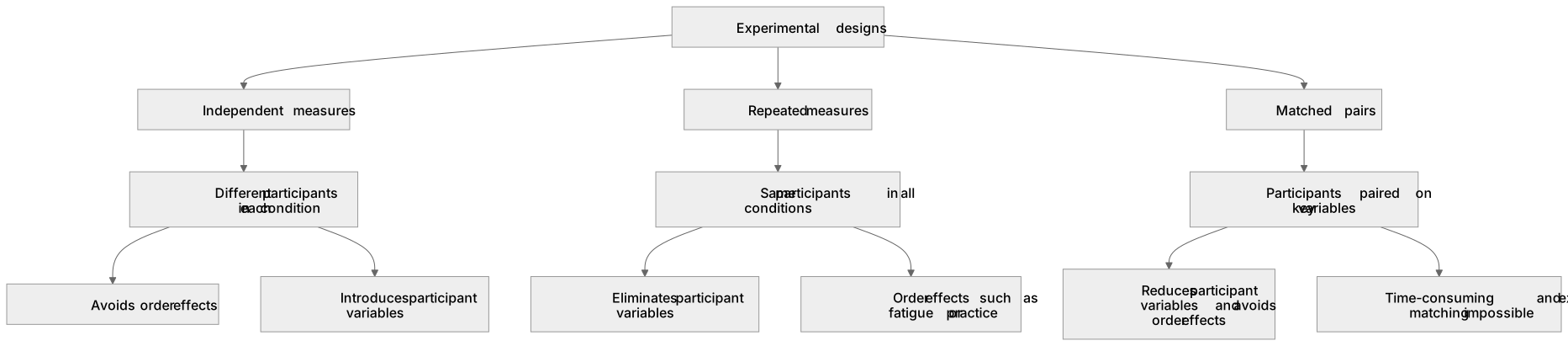
Key words
Say what each word means before you turn the card.
Independent measures
Try answering aloud or in your head before turning the card.
Repeated measures
Try answering aloud or in your head before turning the card.
Matched pairs
Try answering aloud or in your head before turning the card.
See every definition
- Independent measures
- A design in which different participants are used in each condition, which avoids order effects but introduces participant variables.
- Repeated measures
- A design that uses the same participants in all conditions, which eliminates participant variables and requires fewer people, but order effects like fatigue or practice can occur.
- Matched pairs
- A design that pairs participants based on key variables and assigns one from each pair to each condition, reducing participant variables and avoiding order effects, but it is time-consuming and exact matching is impossible.
Label the diagram
Some boxes have lost their names. Pick the right name for each number.
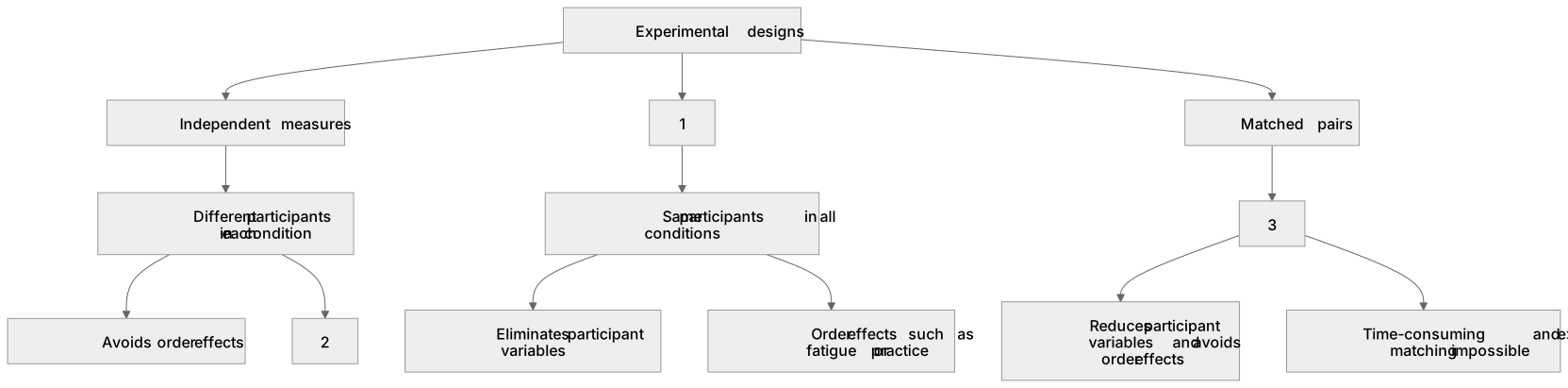
1Box 1
2Box 2
3Box 3
There is more to this lesson
The full lesson goes on to check your understanding and help you earn the marks. Create a free account to carry on, with your progress saved.
A week of Premium from your first lesson · Then the free plan continues · No card, no charge
Test your understanding of Designing psychological research: 11.1.6 Understand experimental and research designs, including strengths and weaknesses: a. independent measures b. repeated measures c. matched pairs
Active recall beats re-reading. Take an instant quiz now to test what you’ve learned and lock it into long-term memory.
A week of Premium from your first lesson · Then the free plan continues · No card, no charge